The Interface Is No Longer the Whole Experience
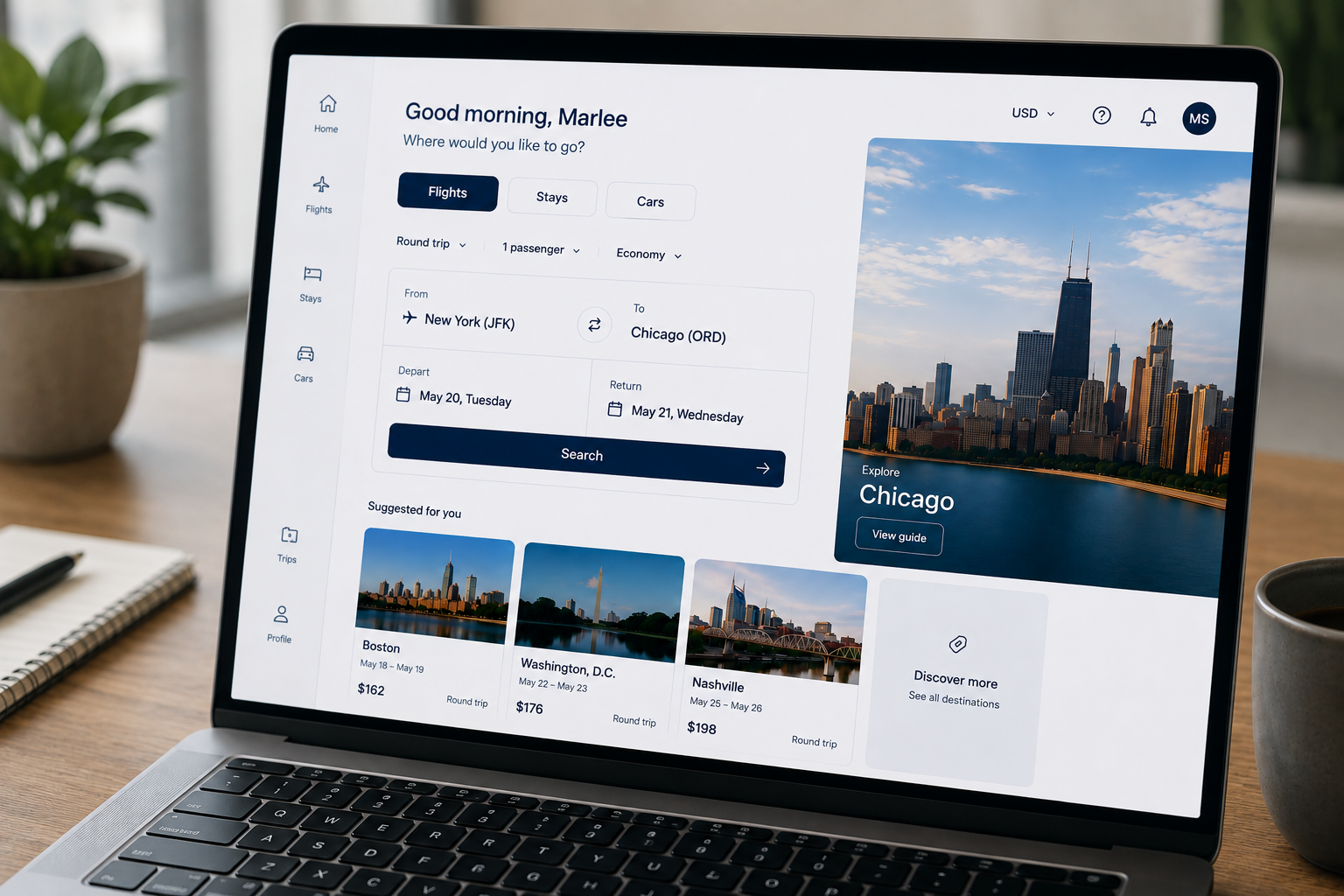
I was booking a flight the other day, and it got me thinking about the whole online booking experience.
Right now, if I want to fly somewhere, I have to do the work: search, enter my dates, compare options, check prices, choose a flight, pick a seat, add a bag, pay, and confirm.
As UX designers, we spend a lot of time crafting ways to make a process like that easier.
But what happens when I don't have to do all of that myself?
What if I could simply say:
“I need to be in Chicago Tuesday morning for a meeting. Keep it under $600, don't give me a 5 a.m. flight, and use my preferred airline if the price is reasonable.”
The system searches. Compares. Understands my preferences. Makes a recommendation. Maybe even books the flight.
Suddenly, the interesting UX problem isn't the flight-search screen anymore.
It's figuring out what “reasonable” means.
It's deciding what the system is allowed to do on my behalf. Knowing when to ask instead of assume. Showing me why it made a particular choice. Giving me a way to intervene when it gets something wrong.
The interface hasn't necessarily disappeared. It just isn't the whole experience anymore.
For decades, we've designed around the assumption that the human will do the work and the system will respond.
Click. Choose. Fill out. Confirm. Submit.
But agentic systems are changing that relationship. They can interpret intent, use context, make decisions, and execute multi-step tasks on our behalf.
That means UX is moving beyond designing the path someone takes through a screen.
We're increasingly designing the relationship between a person and a system that can act.
That raises a different set of questions:
Intent: What is the user actually trying to accomplish?
Trust: How does the user know the system is doing what it should?
Permissions: What can it do without asking?
Transparency: What did it understand, and why did it make that choice?
Control: When should the user be able to intervene?
Recovery: What happens when the system gets it wrong?
Accountability: Who is responsible when an autonomous action has consequences?
If AI does the clicking, who's actually in control?
This is where I think the conversation around UX gets interesting.
We've traditionally equated control with interaction. If I clicked the button, selected the option, or submitted the form, I was making the decision.
But if a system searches, compares, recommends, and acts on my behalf, I may never touch those controls.
Does that mean I've lost agency? Not necessarily.
Recent Human-Computer Interaction (HCI) research suggests that human agency may be relocating rather than disappearing; from controlling individual actions toward setting goals, evaluating outcomes, and negotiating with systems.
That changes what we need to design.
Agency may mean being able to set the goal, define the boundaries, understand the choices being made, evaluate the outcome, change direction, intervene when necessary, and say no.
Research presented at CHI 2026, the leading international conference on Human-Computer Interaction, makes a similar point from a different angle: agentic systems need carefully designed moments of human confirmation and intervention because errors can compound across multi-step tasks.
And this isn't just a theoretical concern. Current HCI research is increasingly framing transparency, human agency, and long-term collaboration as fundamental challenges in what researchers are calling agentic automation experiences.
This also changes how we think about accessibility.
Accessibility can't simply be about whether someone can navigate a screen. As systems become more autonomous, we need to ask whether people can meaningfully direct, understand, question, and intervene in the system itself.
Good UX has always been about helping people accomplish what they came to do.
But now the system may be doing much of the work, and our responsibility is to make sure that convenience doesn't come at the cost of control.
Don't just design for efficiency. Design for agency.
The interface may become less central, but the design problem gets bigger.
We're moving from designing interactions to designing relationships between people and systems.
And I think that's where UX gets really interesting.